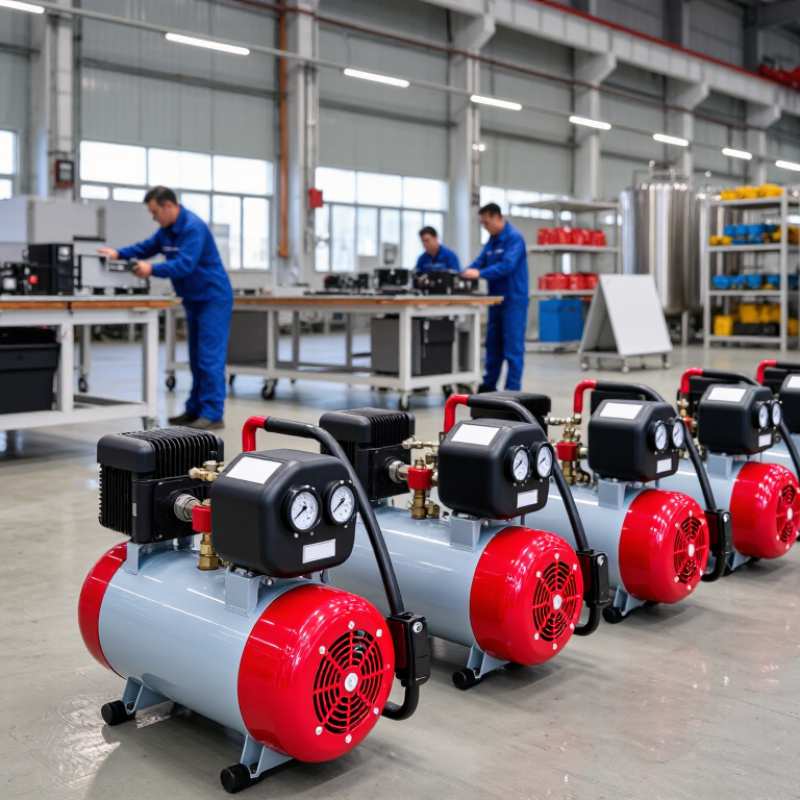
China has become a major manufacturing base for compressed-air equipment, serving workshops, factories, garages, and mobile service teams worldwide. Among these products, the 4 In 1 Air Compressor combines several functions in one compact system. Depending on the model, it may provide inflation, air compression, vacuum operation, and auxiliary power. This combination can save storage space and reduce equipment changes during daily work.
This guide examines China’s top 10 4 In 1 Air Compressor manufacturers through practical and professional criteria. These include manufacturing experience, product design, pressure performance, motor reliability, safety protection, noise control, customization ability, certifications, and after-sales support. Real-world details matter. A durable housing, readable pressure gauge, stable hose connection, and reliable thermal protection can influence performance more than attractive advertising. Small details matter.
The selection also considers factory capabilities, quality-control procedures, export experience, and customer feedback where credible information is available. However, rankings should not be treated as permanent facts. Supplier strengths can change with new product lines, component sources, and service policies. Some manufacturers may publish limited technical data, which requires careful verification before purchasing.
Buyers should compare airflow, maximum pressure, duty cycle, tank capacity, power input, warranty terms, and replacement-part availability. A compressor designed for roadside inflation may not suit continuous factory operation. This distinction is often overlooked. By reviewing these manufacturers carefully, importers and end users can identify more suitable partners, reduce purchasing risks, and make decisions based on measurable performance rather than broad claims.
What Is a 4-in-1 Air Compressor and How Does It Work?
A 4-in-1 air compressor combines four roadside functions in one compact unit. It usually includes a tire inflator, jump starter, power bank, and LED light. A rechargeable battery powers a small motor. The motor drives a piston, compressing air into the tire. A pressure sensor can stop inflation automatically at the selected PSI.
This design is useful during travel, especially when a tire feels soft beside a dark road. NHTSA’s Tire Pressure Monitoring System report found that 27.4% of passenger cars had at least one significantly underinflated tire. The U.S. Department of Energy also notes that low tire pressure can reduce fuel economy. The exact effect depends on the vehicle, load, temperature, and tire condition. That detail is often ignored.
Tips: Check the recommended PSI on the door label, not the tire sidewall. Inflate when tires are cool. Confirm the reading with a separate gauge. Do not treat the built-in light as a repair tool. Battery capacity can fall sharply in cold weather. Also, a 4-in-1 device cannot fix punctures. It only restores pressure temporarily. This is where the convenient design becomes slightly misleading. Test the compressor before an emergency, and inspect its cables, fuse, and charging port regularly.
A 4-in-1 air compressor package commonly combines an air compressor, air receiver tank, refrigerated air dryer, and multi-stage filtration system in one integrated unit. The following table presents anonymous manufacturer capability profiles and representative technical ranges without displaying company or brand names.
| Rank | Anonymous Manufacturer Profile | Compressor Technology | Rated Pressure | Air Delivery Range | Motor Power Range | Integrated 4-in-1 Modules | Typical Air Quality | Typical Applications | Key Selection Strength |
|---|---|---|---|---|---|---|---|---|---|
| 1 | Profile 01 – High-Efficiency Screw Package | Oil-injected rotary screw | 7–13 bar | 1.0–6.5 m³/min | 7.5–45 kW | Compressor, receiver, dryer, particulate/oil filter | Dry, filtered plant air | Factories, CNC equipment, assembly lines | Stable continuous operation and low installation footprint |
| 2 | Profile 02 – Variable-Speed Screw Package | Variable-speed oil-injected screw | 7–13 bar | 0.6–8.0 m³/min | 7.5–55 kW | VSD compressor, receiver, dryer, filters | Dry, filtered air with adjustable output | Variable-load production facilities | Energy savings when demand changes throughout the day |
| 3 | Profile 03 – Compact Workshop Unit | Oil-lubricated reciprocating piston | 8–12 bar | 0.15–0.8 m³/min | 1.5–7.5 kW | Piston compressor, receiver, compact dryer, filter | General-purpose dried air | Garages, maintenance shops, small workshops | Lower initial cost and simple maintenance |
| 4 | Profile 04 – Oil-Free Industrial Unit | Oil-free scroll or reciprocating | 7–10 bar | 0.15–2.0 m³/min | 2.2–15 kW | Oil-free compressor, receiver, dryer, fine filter | Oil-free, dry compressed air | Laboratories, electronics, dental and medical support systems | Reduced risk of oil contamination |
| 5 | Profile 05 – Laser-Cutting Air Package | Oil-free screw or scroll | 8–16 bar | 0.5–4.0 m³/min | 5.5–30 kW | Compressor, receiver, dryer, high-efficiency filtration | Low-oil, dry, particle-controlled air | Laser cutting, plasma cutting, precision fabrication | Clean and consistent air for sensitive equipment |
| 6 | Profile 06 – High-Pressure Configuration | Two-stage reciprocating or screw | 16–30 bar | 0.1–2.5 m³/min | 5.5–37 kW | High-pressure compressor, receiver, dryer, filters | Dry, filtered high-pressure air | PET preform production, testing, specialized automation | Suitable for applications requiring pressure above standard plant levels |
| 7 | Profile 07 – Low-Noise Scroll Package | Oil-free scroll | 7–9 bar | 0.2–1.5 m³/min | 2.2–11 kW | Scroll compressor, receiver, dryer, coalescing filter | Clean and dry air | Clinics, laboratories, offices and indoor workshops | Low vibration and relatively quiet operation |
| 8 | Profile 08 – Heavy-Duty Factory Package | Fixed-speed rotary screw | 7–16 bar | 5.0–20 m³/min | 37–132 kW | Industrial compressor, large receiver, dryer, line filtration | Dry, filtered production air | Automotive, textiles, metal processing and large factories | High flow capacity for continuous multi-point demand |
| 9 | Profile 09 – Portable Integrated Unit | Compact piston or screw | 7–12 bar | 0.2–1.2 m³/min | 2.2–11 kW | Compressor, compact receiver, dryer, basic filter | General-purpose dry air | Mobile service, construction and field maintenance | Easy relocation and fast deployment |
| 10 | Profile 10 – Customized OEM Configuration | Screw, scroll or piston according to specification | 7–30 bar | 0.15–20 m³/min | 2.2–132 kW | Selected compressor, receiver, dryer, filtration and controls | Specified according to application | Automation, packaging, food processing and special machinery | Flexible layout, voltage, pressure and control customization |
Technical ranges are representative industry configuration ranges rather than claims for any named company. Actual performance depends on ambient temperature, inlet conditions, operating pressure, receiver size, dryer type, filtration grade, power supply and applicable safety standards.
It commonly combines an air compressor, air receiver, refrigerated dryer, and filtration system. Some packages use an oil-water separator instead. Confirm the exact configuration before purchasing.
Filtration affects air quality and maintenance. An oil-water separator serves a different purpose. The difference can change installation costs and service routines.
Variable-speed models adjust motor output when demand changes. Fixed-speed models often cost less initially. They may consume more power during low-load periods.
Air leaks and poor system design can waste significant energy. Check automatic drains, leak monitoring, and cooling performance. Inspect pipe joints carefully.
Not safely. Manufacturers may use different pressure and testing conditions. Request ISO 1217 testing or equivalent documentation before comparing figures.
Compare peak demand, working pressure, receiver size, and airflow. A compact unit may look attractive. It can still struggle during production peaks.
Review machining equipment, assembly controls, and final testing records. Inspect welds, pipe connections, wiring labels, and drain access. Small details reveal workmanship.
Ask for datasheets, quality certificates, electrical safety documents, manuals, and spare-parts lists. Confirm warranty exclusions and response times. Unclear answers deserve reflection.
Yes. A sample can reveal noise, wiring quality, drainage access, and actual dimensions. Test it under realistic demand. Do not trust photographs alone.
Do not choose only by price. Cheaper equipment may involve thinner materials or weaker testing. I might still miss local service limits, so consult an experienced engineer.
This guide introduces the 4 In 1 Air Compressor, a multifunctional system that combines air compression with several practical functions, such as inflation, pressure measurement, and auxiliary power or lighting support. It explains how these functions work together, why integrated designs are useful, and which technical factors influence performance, including motor efficiency, airflow, pressure range, noise control, cooling, portability, and safety protection.
The article also presents a structured overview of ten leading Chinese manufacturers, selected according to production capability, product quality, research and development strength, certifications, customization services, reliability, and customer support. It compares their key technologies, configurations, materials, and product differences without focusing on brand promotion. Finally, the guide offers practical advice for choosing a suitable manufacturer by considering application requirements, expected workload, product durability, quality control, delivery capacity, after-sales service, and total purchasing cost.

 Smart Air