Choosing an Integrated Air Compressor is not just a matter of comparing brand names. These compact systems can combine a compressor, air dryer, filters, and receiver in one package, saving floor space and simplifying installation. Yet configurations differ. One unit may suit a small workshop, while another is designed for continuous industrial demand.
This guide introduces ten manufacturers for global buyers and considers the details that matter beyond headline capacity. Look at rated flow at the required pressure, duty cycle, energy use, noise levels, and the air quality your process needs. A clear product datasheet helps, but so does knowing whether local technicians can provide routine service and replacement parts. A polished brochure is not proof. Ask for test conditions and compare like with like.
Regional support can change the real cost of ownership. So can delivery time. Buyers should check applicable technical requirements in their destination market and confirm what each package includes, from controls to condensate management. The manufacturers featured here offer a starting point for research, not a universal ranking for every application. Even a careful shortlist has limits. Your operating hours, available space, and maintenance capacity may point to a less obvious choice.
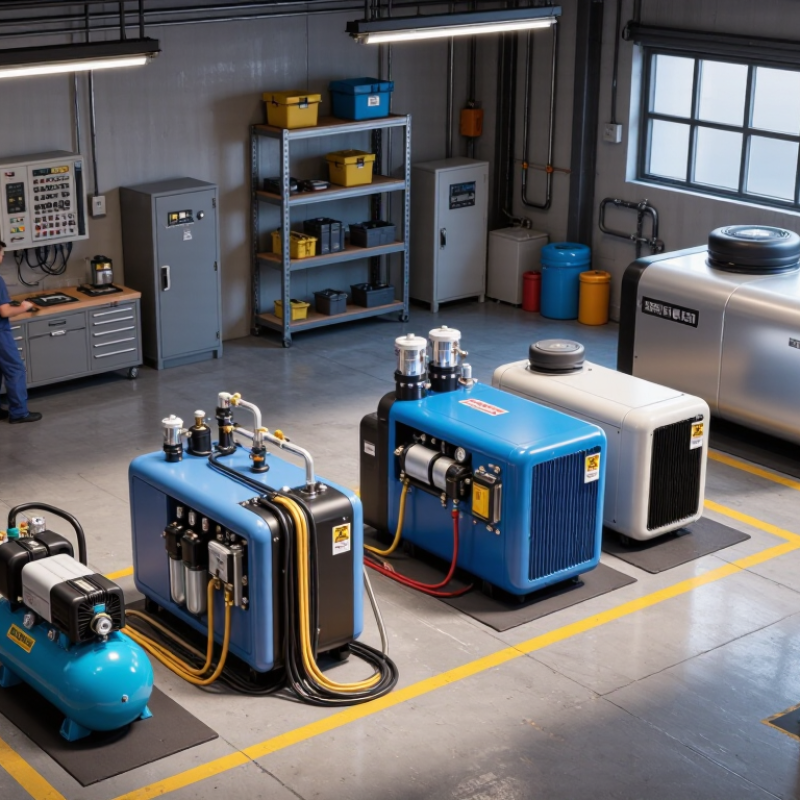
An integrated air compressor combines air generation and supporting equipment in one coordinated package. Instead of connecting separate machines across a plant, buyers receive a system designed to deliver compressed air from a compact footprint. The exact configuration varies with pressure, flow, air-quality requirements, and operating conditions.
The compressor is the core, driven by an electric motor. A receiver tank stores air and helps smooth pressure fluctuations during changing demand. A refrigerated or desiccant dryer reduces moisture, while filters capture oil aerosols and solid particles. Clean air matters. A control panel monitors pressure, temperature, and alarms, and may coordinate multiple units. Valves and drainage points also matter: a blocked condensate drain can undermine an otherwise capable system.
In a workshop, the difference may show up as fewer scattered pipes and simpler daily checks. But “integrated” does not mean maintenance-free. Buyers should check access to filters, belts, drains, and service panels before installation. One detail is easy to overlook: the package’s outlet air quality must match the tools or process using it. Oversizing can waste energy, while undersizing may cause pressure drops during peak demand. The right layout depends on actual usage, not just the compressor’s headline rating.
What it is: An integrated air compressor is a packaged system that combines compressed-air generation with some or all of the equipment needed for air cooling, moisture removal, filtration, storage, and control. The exact package varies by model; not every system includes every component listed below.
| No. | Core component | Purpose in the system | Practical buyer checks |
|---|---|---|---|
| 1 | Compressor element (airend) | Raises air pressure by reducing the volume available to the air. Common designs include rotary screw, reciprocating, and centrifugal compressors. | Confirm the compressor type, rated flow and pressure, duty requirements, and suitability for the expected operating schedule. |
| 2 | Electric motor or drive | Supplies mechanical power to the compressor element. The drive may run at a fixed speed or vary its speed to match demand. | Check voltage, frequency, phase, motor efficiency, starting method, and whether variable-speed control is included or optional. |
| 3 | Intake filter | Captures airborne particles before they enter the compressor, helping protect internal components. | Review the filter’s replacement interval, availability, and the effect of the installation environment on filter life. |
| 4 | Aftercooler | Cools compressed air downstream of compression. Cooling causes some water vapor to condense, making it easier to remove moisture. | Check the cooling method, ventilation or cooling-water needs, and the specified operating-temperature limits. |
| 5 | Moisture separator | Separates liquid water formed during cooling from the compressed-air stream. | Verify that separated condensate can be drained reliably and that the separator is accessible for inspection and maintenance. |
| 6 | Air dryer | Reduces water vapor in compressed air. Refrigerated dryers are commonly used for general-purpose air; desiccant dryers can achieve lower dew points. | Specify the required pressure dew point and check dryer performance at the actual inlet temperature, pressure, and flow conditions. |
| 7 | Compressed-air filters | Remove contaminants such as particles, oil aerosols, or vapors, depending on the filter type and system design. | Match filtration stages to the application’s air-quality requirements. Check pressure drop, element replacement needs, and any required downstream testing. |
| 8 | Air receiver (storage tank) | Stores compressed air, helps buffer short-term demand fluctuations, and can support pressure stability. | Confirm whether a receiver is included, its usable capacity and pressure rating, and applicable local inspection and safety requirements. |
| 9 | Controller and sensors | Monitor operating conditions and coordinate functions such as start/stop, pressure control, alarms, and—on some systems—variable-speed operation. | Check available monitoring signals, alarm history, communication options, control settings, and compatibility with plant systems. |
| 10 | Condensate drains and discharge management | Remove collected liquid from separators, dryers, and filters. Condensate from oil-lubricated compressors may require treatment before disposal. | Check drain type and maintenance access. Confirm that condensate handling complies with local environmental and wastewater rules. |
It combines a compressor and supporting equipment in one coordinated package. A receiver tank, dryer, filters, controls, and drains may be included. Configurations vary.
It stores compressed air and helps smooth pressure changes when demand rises or falls. It is not a fix for every pressure problem.
Dryers reduce moisture, while filters capture particles and oil aerosols. Choose treatment based on the air quality your tools or process need. Clean air matters.
Check measured airflow and power at stated test conditions. Ask whether figures cover the complete package, including its dryer. A bare compressor may deliver different usable airflow.
It provides test methods for displacement compressors, including capacity and power. Inlet temperature, pressure, and humidity can affect reported results.
It classifies compressed-air purity for particles, water, and oil. Check test results at the point of use, after air treatment. Site conditions still vary.
A commonly cited estimate is about 10% of electricity used in U.S. manufacturing. It is a benchmark, not a measurement for every plant. Leaks add up.
Match pressure and airflow to real demand, including peak use. Check access to filters, belts, drains, and service panels before installation. Listen for hiss near fittings. Oversizing can waste energy, while undersizing may cause pressure drops. I might be missing a site-specific detail; measure actual demand.
An Integrated Air Compressor combines the compressor, motor, controls, and often air-treatment components into a coordinated system designed to deliver reliable compressed air. Understanding how these components work together helps buyers assess efficiency and suitability for their applications. ISO 1217 provides methods for measuring compressor performance, while ISO 8573-1 classifies compressed-air quality by contaminants such as particles, water, and oil. These standards offer a common basis for comparing equipment and specifying air requirements.
Compressed air can account for about 10% of industrial electricity use, making energy efficiency and lifecycle cost important considerations. This overview examines ten manufacturers and their product offerings and global reach without focusing on brand promotion. Buyers can compare operating pressure, capacity, energy consumption, maintenance needs, and service-network coverage to identify equipment that matches their production demands and long-term operating priorities.

 Smart Air