Choosing the 2026 best Rotary Screw Air Compressor requires more than comparing horsepower, price, or a glossy efficiency label. Global buyers face different electricity costs, ambient temperatures, voltage standards, service networks, and production pressures. A compressor that performs well in a cool European factory may struggle in a dusty workshop near a tropical port.
Ron Marshall, a respected compressed-air systems specialist, offers a practical warning: “A compressor is only as efficient as the system around it.” That principle should guide this comparison. The strongest candidates must deliver stable pressure, suitable airflow, efficient part-load performance, and dependable operation under real working conditions. Small details matter. A clogged intake filter, a leaking hose, or an incorrectly sized receiver can quietly increase energy use every hour.
Look beyond the nameplate. Examine specific power, variable-speed control, oil-injected or oil-free design, air treatment, noise levels, maintenance access, and documented testing. ISO 8573-1 air-quality requirements may also affect the final choice, especially in food, pharmaceutical, electronics, and precision manufacturing applications. Local technicians and spare-parts availability deserve equal attention.
There is no universal winner.
That is the uncomfortable part. Some buyers may overvalue initial savings and underestimate five-year energy costs. Others may choose advanced controls without measuring demand first. This guide evaluates leading 2026 models through a buyer-focused lens, combining technical evidence, operating experience, lifecycle economics, and supplier credibility. The goal is not to promote the largest machine. It is to identify the Rotary Screw Air Compressor that fits the application, the location, and the risks behind the purchase.
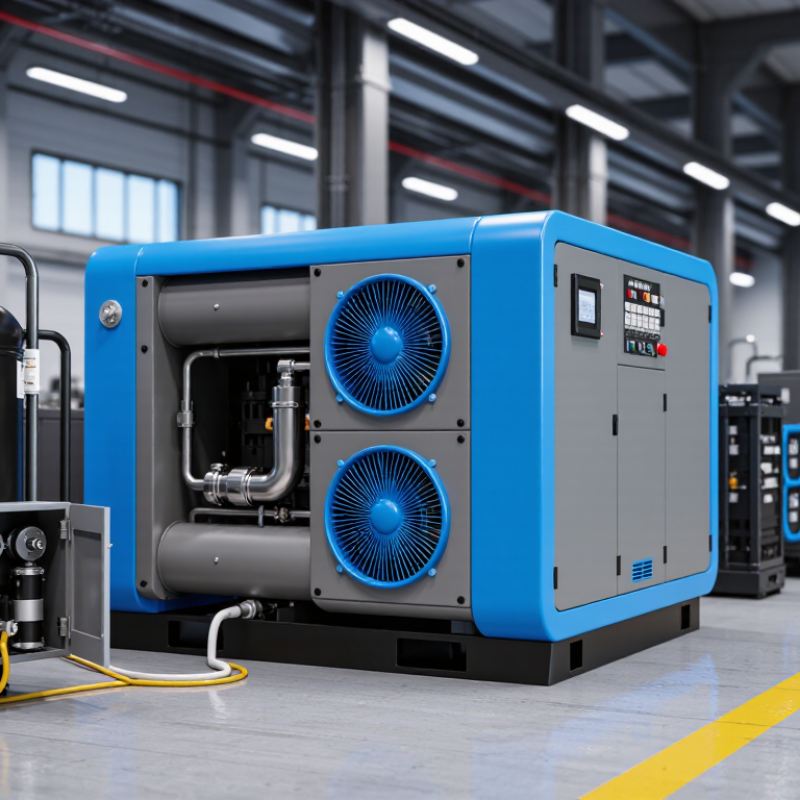
A rotary screw air compressor is a positive-displacement machine that produces compressed air continuously. Two precisely shaped rotors turn inside a metal chamber. One rotor drives the other, while small clearances prevent air from escaping.
Air enters through an inlet valve and fills the spaces between the rotors. As the rotors rotate, these spaces become smaller. The trapped air is compressed gradually, not in sudden piston strokes. This creates a steady airflow for factories, workshops, packaging lines, and automated equipment.
Many industrial models use oil injection to reduce heat, seal internal gaps, and protect moving parts. The air and oil mixture then enters a separator tank. A filter removes most oil before the air reaches the outlet. Oil-free designs use different cooling and sealing methods, but their operating costs can be higher. That detail is often overlooked.
A motor, controller, and pressure sensor regulate production. Variable-speed control can reduce wasted electricity when demand changes during a shift. Fixed-speed machines may suit stable, high-volume use. Buyers should check pressure, flow rate, voltage, ambient temperature, service access, and local electrical requirements. A compressor that looks efficient on paper may perform poorly in a dusty room or hot climate. I have seen specifications create false confidence when installation conditions were ignored. Performance depends on the whole system, not the compressor alone.
It is a positive-displacement machine for continuous compressed air. Two rotors turn inside a metal chamber. Air enters between them. The shrinking spaces compress it gradually. This produces steady airflow without sudden piston strokes.
An inlet valve admits air into the rotor spaces. The rotors then reduce those spaces. Pressure increases as the trapped air moves forward. The process is smooth and continuous. Think of a controlled metal squeeze.
Oil-injected models use lubricant for cooling, sealing, and component protection. A separator removes most oil before delivery. Oil-free models use other cooling and sealing methods. They suit sensitive air applications. Oil-free does not mean maintenance-free.
Variable-speed control suits factories with changing air demand. It reduces unloaded running during quieter periods. Fixed-speed machines suit stable, high-volume production. Oversizing can waste electricity. Peak demand alone is not enough.
Check pressure, airflow, operating hours, voltage, frequency, and ambient temperature. Also review altitude, dust, humidity, noise limits, and service access. Ask for measured airflow data. Catalogue ratings may create false confidence.
Provide a clean, level foundation and reliable ventilation. Leave space around the unit for maintenance. Keep intake air away from exhaust and chemical vapors. Use suitable piping, drains, valves, and a receiver tank. Small layout mistakes matter.
Inspect filters, separators, drains, vibration, temperature, and air leaks. Replace filters when restriction increases. Follow operating conditions, not only calendar dates. Record pressure and motor current after startup. Delayed small repairs can become expensive downtime.
No single choice fits every site. A cool warehouse differs from a hot production line. Dusty rooms need stronger intake protection. Coastal locations may need corrosion control. The best specification can still fail after poor installation. That deserves honest review.
Choosing the best Rotary Screw Air Compressor for global industrial use in 2026 requires more than comparing price and horsepower. This guide explains how rotary screw technology works, how continuous air compression supports demanding operations, and which compressor types are suitable for factories, workshops, construction environments, and other industrial applications. It also outlines how to evaluate air capacity, energy efficiency, operating pressure, duty cycle, noise levels, and lifecycle costs according to specific production requirements.
For international buyers, the article highlights important considerations such as electrical compatibility, safety features, control systems, documentation, serviceability, and commonly recognized quality standards. It also provides practical guidance on selecting the correct configuration, preparing the installation site, ensuring proper ventilation and air treatment, and establishing a preventive maintenance plan. By balancing performance, reliability, energy consumption, and long-term support, buyers can choose a compressor solution that delivers stable compressed air and dependable value across different operating conditions.

 Smart Air